


Views: 0 Author: Site Editor Publish Time: 2026-08-28 Origin: Site


Tightening environmental regulations, including EEDI, CII, and EEXI, alongside volatile fuel costs, force commercial shipyards and naval architects to extract every fraction of a percent of hydrodynamic efficiency from new builds and refits. Standard cast propellers from massive stock catalogs often fail to match the specific wake field of specialized hull forms. Relying on off-the-shelf propulsion frequently results in parasitic drag, destructive cavitation, structural vibration, and compromised fuel economy.
To meet modern maritime demands, bespoke propulsion solutions are necessary. This guide provides a technical framework for shipyards to evaluate custom marine propulsion, assess manufacturing partners, and mitigate implementation risks during installation and sea trials.
Performance Alignment: Custom designs utilize advanced Computational Fluid Dynamics (CFD) and proprietary hydrodynamic code to match the propeller to the vessel’s specific engine torque curve (including instant-torque electric/hybrid powertrains), gear ratio, and hull wake field.
Material & Structural Integrity: Choosing between cast and forged manufacturing processes, and selecting the correct alloy (e.g., Nickel-Aluminum-Bronze vs. Duplex Stainless Steel), dictates lifecycle maintenance costs, mechanical strength, and galvanic corrosion resistance.
Vendor Vetting: A reliable marine propeller manufacturer must demonstrate verifiable compliance with ISO 484 tolerance standards (Class S/Class I) and possess in-house capabilities for major Class Society certifications (ABS, DNV, Lloyd’s Register).
Installation Precision: Proper yard-level installation protocols—including precise blue-fitting for shaft taper matching and correct torque sequencing for the "Big Nut / Little Nut" rule—are critical to realizing the engineered benefits of a custom ship propeller.
Standard manufacturer catalogs feature hundreds of pre-designed SKUs, creating the illusion of comprehensive coverage. These off-the-shelf options are engineered for generalized hull shapes operating in idealized conditions. They cannot account for localized boundary layer flow and wake-field non-uniformity specific to a unique vessel. Specifying Custom Marine Propellers ensures the blade geometry is mathematically matched to the exact hydrodynamic profile of the hull, eliminating the inefficiencies inherent in mass-produced designs.
Standard propellers become an operational liability when applied to specialized commercial vessels. Tugs, trawlers, and research vessels feature unique hull geometries that heavily disrupt water flow before it reaches the propeller disc. Research vessels require strict acoustic signature management to mitigate Noise, Vibration, and Harshness (NVH) that interferes with sonar equipment. Vessels transitioning to electric or hybrid propulsion systems present a unique challenge. These powertrains deliver flat, instant torque curves. Applying instant torque to a standard propeller causes immediate aeration, severe blade-loading issues, and cavitation. Custom blade geometry is required to absorb and translate this instant rotational force into forward thrust smoothly.
Shipyards must establish strict baseline metrics to justify custom engineering. Success criteria should include targeted percentage reductions in fuel consumption, adherence to specific vibration limits outlined in ISO 20283-5, and exact bollard pull or top-speed requirements. Custom engineering demands extended lead times and initial design coordination. This upfront coordination yields long-term operational savings, significantly reduced drivetrain wear, and distinct emissions compliance advantages for the vessel operator.
Feature | Standard Stock Propeller | Custom Engineered Propeller |
|---|---|---|
Wake Field Adaptation | Generic, assumes uniform flow | Fully mapped via CFD for specific hull |
Cavitation Risk | High on specialized hulls | Minimized through variable pitch and skew |
Vibration (NVH) | Often requires post-install tuning | Engineered to meet ISO 20283-5 limits |
Lead Time | Short (Off-the-shelf) | Extended (Requires engineering & casting) |
Efficiency Gain | Baseline | Optimized for specific RPM and draft |
The decision to move away from catalog options requires a clear understanding of the vessel's operational profile. A harbor tug operating primarily at low speeds with high bollard pull requirements needs a vastly different blade area ratio than a fast ferry prioritizing top-end speed and fuel efficiency. A custom ship propeller addresses these exact operational parameters, ensuring the engine operates within its optimal load curve without lugging or over-revving.
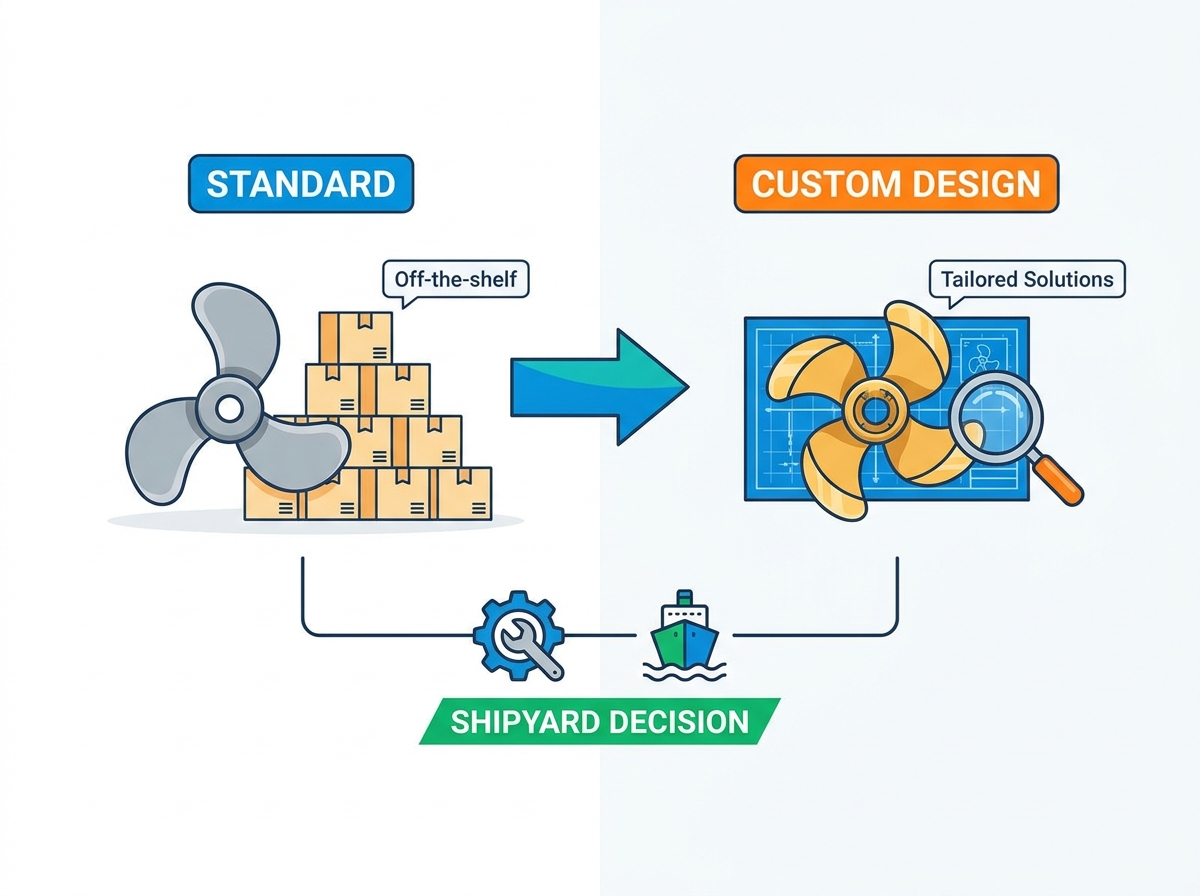
A professional propeller design service relies on proprietary hydrodynamic code alongside advanced Computational Fluid Dynamics (CFD) software. Analyzing the velocity distribution of water entering the propeller disc is a mandatory step in the design phase. Water does not flow uniformly into the propeller; the hull creates areas of high and low velocity. By mapping this wake field, engineers design blade sections that accommodate these variations, preventing localized blade-root cavitation and minimizing pressure pulses against the hull.
Geometry optimization involves manipulating multiple variables simultaneously. Engineers adjust the diameter, variable pitch (the changing angle of attack across the blade span from root to tip), blade count, skew, rake, and Blade Area Ratio (BAR). Increasing skew delays the blade's entry into the highest density areas of the wake field, significantly reducing vibration. Adjusting the BAR balances the thrust generated against the engine load, ensuring the engine reaches its maximum rated RPM without overloading.
During the design phase, shipyards evaluate the operational profile to choose between a controllable pitch system and a highly optimized fixed pitch propeller. A fixed pitch system offers lower mechanical complexity, reduced maintenance requirements, and maximum hydrodynamic efficiency at a specific design draft and RPM. A controllable pitch system provides operational flexibility across varied towing and transit profiles, allowing the vessel to maintain engine efficiency at different speeds, though it requires higher capital investment and complex hydraulic maintenance.
The engineering phase must also account for the interaction between the propeller and the rudder. The slipstream generated by the propeller directly affects rudder authority and steering efficiency. Custom designs often incorporate specific rake angles to optimize the distance between the blade trailing edge and the rudder leading edge, improving maneuverability while reducing turbulent wash.
The structural integrity of a propeller is dictated by its manufacturing process. Evaluating the differences between casting and forging is critical. Forged ship propellers provide superior grain refinement and higher tensile strength compared to traditional sand-cast propellers. This increased strength allows engineers to design thinner blade profiles, which reduces rotational inertia, improves engine responsiveness, and decreases drag. Complex geometries often require advanced casting techniques followed by rigorous thermal treatments.
A competent marine propeller manufacturer must possess deep metallurgical expertise. The choice of alloy directly impacts the vessel's maintenance lifecycle. Manganese Bronze serves as a standard option but lacks long-term durability in harsh environments. Nickel-Aluminum-Bronze (NiAlBz) is the industry standard for commercial applications, offering exceptional tensile strength, superior cavitation erosion resistance, and excellent weld-repairability. For ice-class vessels or those operating in highly abrasive environments, Duplex Stainless Steel provides maximum durability and impact resistance.
Alloy Type | Tensile Strength | Corrosion Resistance | Best Application |
|---|---|---|---|
Manganese Bronze | Moderate | Fair | Light commercial, fresh water |
Nickel-Aluminum-Bronze | High | Excellent | Heavy commercial, saltwater, standard industry use |
Duplex Stainless Steel | Very High | Superior | Ice-class, abrasive environments, high-impact zones |
Modern performance requirements render hand-grinding insufficient. Achieving the precise geometry dictated by CFD requires multi-axis (5-axis) CNC machining. This technology ensures the finished product meets ISO 484/1 (for propellers over 2.5m) and ISO 484/2 (for propellers under 2.5m) Class S (Very High Accuracy) or Class I (High Accuracy) tolerances. Deviations of even a millimeter in pitch or blade section thickness induce vibration and reduce efficiency.
A reliable shipyard propeller supplier handles all major classification society approvals in-house. This includes coordinating physical material testing, such as tensile and impact tests from the actual pour, and conducting non-destructive testing (NDT), including dye penetrant and ultrasonic inspections. Navigating surveyor inspections for DNV, ABS, RINA, Bureau Veritas, or Lloyd's Register ensures the propulsion system meets all international safety and insurance standards.
The most advanced hydrodynamic design can be compromised by poor yard-level installation. Shaft integration and taper matching carry significant risk. Poor hub-to-shaft fitment leads to fretting, keyway stress concentration, and eventual shaft failure. The shipyard is responsible for performing a strict "blue-fitting" check. This involves applying Prussian Blue dye to the shaft taper, mounting the propeller, and removing it to inspect the contact pattern. A minimum contact area of 70-80%, evenly distributed, is required before final assembly.
Securing the propeller to prevent axial movement requires strict adherence to mechanical protocols, specifically the "Big Nut / Little Nut" rule. Incorrect mechanical sequencing leads to thread-mating issues and catastrophic propeller loss when the vessel backs down. The authoritative installation protocol dictates:
Clean the shaft taper and propeller bore thoroughly with an approved solvent to remove all grease and debris.
Apply Prussian Blue dye to the shaft taper and perform the fitment check, ensuring the required 70-80% contact area.
Install the propeller onto the shaft without the key to verify the advance distance up the taper.
Install the key, ensuring proper clearance at the top of the keyway to prevent the hub from riding on the key rather than the taper.
Install the thin (little) nut first. Torque it to a partial specification, typically 30-50% of full torque. This action fully draws and seats the propeller onto the shaft taper.
Install the thick (big) nut behind the thin nut. Torque the thick nut to 100% of the full engineering specification. This transfers the primary tension load to the thick nut, utilizing the thin nut as a heavy-duty locking jam nut.
Secure the assembly with the appropriate locking mechanism, such as a cotter pin or locking plate, depending on the shaft design.
Sea trial validation is the final step in mitigating implementation risk. Shipyards collect specific physical and digital data points to verify the custom design. This includes monitoring exhaust gas temperatures (EGT) and engine load percentages across the entire RPM curve to ensure the engine is not overloaded. Torsional and hull vibration analysis must be conducted to verify compliance with ISO standards. Speed-run verification against the design's predictive power-speed curve confirms the hydrodynamic efficiency of the installation.
Procuring custom propulsion requires precise timeline management. Custom manufacturing timelines range from 12 to 24 weeks, depending on the complexity of the casting, the necessity of new patterns, and the availability of Class Society surveyors. Shipyards integrate the design service during the initial naval architecture and hull-form optimization phases to avoid delaying the vessel's launch date.
Evaluating vendors requires looking beyond standard catalog availability. Shipyards assess the vendor's engineering capability, specifically their proficiency with wake-adapted design and CFD. Foundry capacity is verified to ensure they can pour the required alloy and handle the physical dimensions of the propeller. A proven history of managing Class Society certifications and delivering ISO Class S or Class I tolerances via 5-axis CNC machining is non-negotiable for commercial vessel applications.
Communication between the shipyard's engineering team and the manufacturer's hydrodynamicists must remain open throughout the build process. Any changes to the vessel's weight distribution, hull appendages, or engine specifications must be relayed immediately, as these alterations directly impact the required propeller geometry.
Shipyards should request detailed inspection reports from the manufacturer prior to shipping. These reports must include the final pitch measurements across multiple radii, dynamic balancing certificates, and the results of all non-destructive testing. Reviewing this documentation before the propeller arrives at the yard prevents installation delays and ensures the delivered product matches the engineered specifications.
Proper handling and storage upon arrival at the shipyard are equally important. Propellers should be stored on wooden blocks to prevent damage to the blade edges and kept covered to protect the machined bore from debris and moisture. Lifting should only be performed using approved nylon straps positioned around the hub, never by the blades, to prevent inducing stress fractures or altering the pitch.
By treating the procurement and installation of custom propulsion as a highly integrated engineering project rather than a simple parts purchase, shipyards guarantee the final vessel meets its performance targets and regulatory requirements.
The integration of custom propulsion systems demands a rigorous approach to quality control at every stage, from the initial CFD analysis to the final torque sequence on the slipway. Shipyards that master this process deliver vessels with superior operational capabilities, lower fuel consumption, and reduced maintenance profiles.
Compile the vessel’s lines plans, engine power-curves, and gearbox ratios to establish a baseline for propulsion requirements.
Initiate a preliminary design consultation with a specialized manufacturer to analyze the hull's specific wake field.
Establish strict yard-level protocols for blue-fitting and torque sequencing prior to the arrival of the propulsion equipment.
Define clear, measurable success criteria for sea trials, including specific EGT limits, vibration thresholds, and speed-power validation.
A: Realistic manufacturing timelines range from 8 to 24 weeks. This duration depends heavily on the propeller's diameter, whether new casting patterns must be fabricated, specific alloy cooling times, CNC machining schedules, and the availability of Class Society surveyors for mandatory material and NDT inspections.
A: Diameter is twice the distance from the center of the hub to the outermost blade tip. Pitch is defined as the theoretical forward distance the propeller travels in one full 360-degree rotation through a solid medium. Custom designs utilize variable pitch, changing the angle of attack across the blade radius.
A: Nickel-Aluminum-Bronze (NiAlBz) is the premier choice for commercial applications. It provides a superior strength-to-weight ratio, excellent cavitation-erosion resistance, and inherent anti-fouling properties. For extreme environments, such as ice-breaking, Duplex Stainless Steel is specified for its high impact resistance.
A: Engineers utilize wake-adapted design principles, analyzing water flow into the propeller disc. By applying specific skew and rake modifications, and unloading the blade tips, they ensure the blades enter the water column smoothly. This balances pressure distribution, mitigating localized cavitation and hull pressure pulses.
A: ISO 484 defines international standards for manufacturing accuracy. For custom performance and maximum efficiency, propellers must meet Class S (Very High Accuracy) or Class I (High Accuracy). Standard off-the-shelf propellers often only meet Class II or Class III, allowing deviations that induce vibration.
A: The mechanical standard requires installing the thin (little) nut first to draw and set the propeller onto the taper, torqued to a partial specification (30-50%). The thick (big) nut is installed second and torqued to 100% capacity. This ensures the thick nut carries the primary axial load.


